



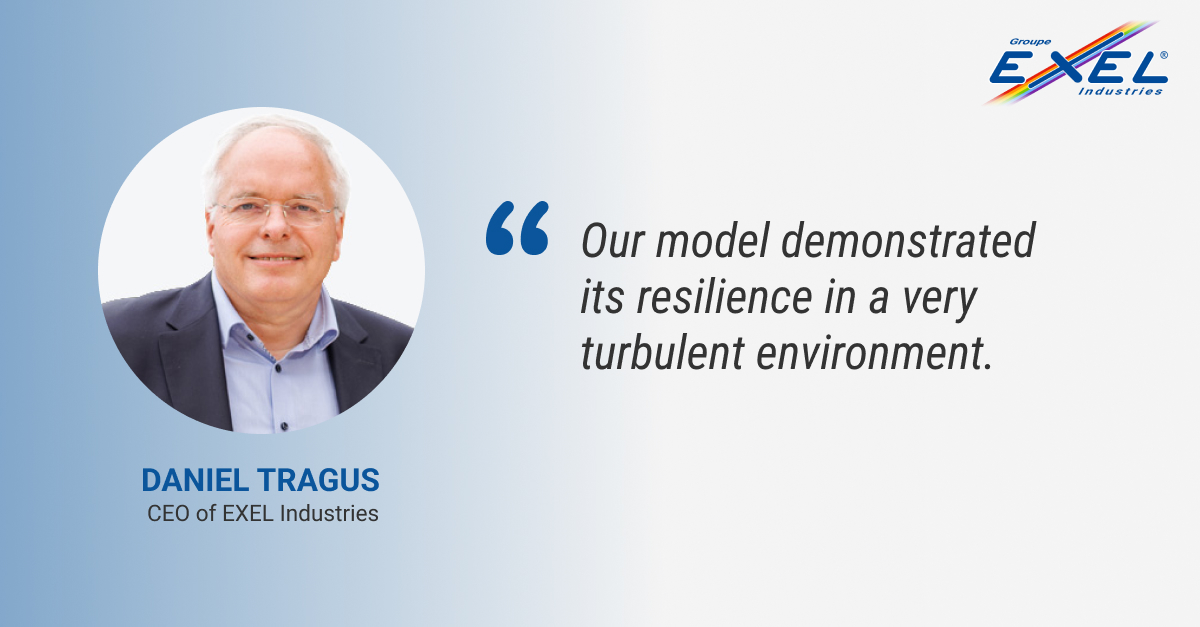
The year, in 2024–2025, was once again marked by numerous crises and tensions around the world. How do you view this unstable context, and what are its consequences for EXEL Industries in terms of performance?
Daniel Tragus - We live in an increasingly unpredictable and volatile world. The uncertainties linked to the US tariff policy are a perfect illustration of this reality, since they have generated a wait-and-see attitude worldwide and a relative instability in the business climate. They have also generated additional costs that we have had to pass on in our sales prices. Looking at our markets, the agricultural segment is in decline, while the industrial segment is stable, with contrasting phases of growth depending on the region and the range. The Garden business, meanwhile, has made good progress. Once again, the diversification of our activities has enabled us to better withstand shocks. Nevertheless, our total annual revenue fell by 10.6% to €983 million. Despite this deteriorated climate, our cash flow increased to €101 million, underpinned by a marked improvement in our working capital requirements. Lastly, the Group’s debt was down €30 million, which is good news.
What were the main developments that marked the year? What do they say about the Group’s evolution?
D. T. - Throughout the year, we initiated or completed a number of structuring projects. First, in terms of investments, as we continue to modernize our information systems and production tools. We put a new ERP system in place at Sames and completed work on the Stains site, which is now fully operational. Next, in terms of development and innovation, we launched three new self-propelled machines at Agrifac, developed an ambitious product plan across all our companies that is ongoing, and opened Sames and Agrifac subsidiaries in Canada, which will enable us to better meet the current challenges in North America. We also implemented various measures to boost our after-sales services and made significant progress in the circular economy. Lastly, with regard to social matters, we conducted our second ’barometer’ survey, which recorded an 80% participation rate worldwide. Beyond this score, which we are delighted with, we observed an improvement in the level of engagement among our employees. This is a sign that we are on the right track and that our action plans are bearing fruit. I would add that we continue to provide support for our teams as they develop their skills, notably through an artificial intelligence training program. Already integrated into our industrial processes and some of our products for several years, artificial intelligence is now set to be rolled out more widely in order to develop new use cases and increase productivity.
Sustainability issues are driving political debate in Europe and North America. How is the Group tackling the climate and ecological transition?
D. T. - This is an issue to which we are fully committed. We published our first sustainability report in CSRD format, and now have reliable information and indicators. While this initiative, which actively involved our teams, provides us with a snapshot of our current maturity in ESG matters, it also enabled us to initiate a number of actions, notably around the environmental pillar, where our goal is to optimize our Scope 3 carbon footprint. The use of HVO biofuel, the search for greater energy efficiency in our machines, the development of hybrid systems, and electrification initiatives are all part of our efforts to improve our environmental footprint. Our goal is simple: we want to provide our customers with solutions that combine economic performance with respect for the environment. We are also working, as we have in the past, to ensure that our customers minimize their use of phytosanitary products as much as possible. In short, we continue to make progress and develop our structure around these sustainability issues, which are overseen by the holding company.
What goals have you set for EXEL Industries in 2025–2026?
D. T. - The strategy can be summarized in three themes: controlling our production and structural costs, pursuing our product innovation and modernization plans, and improving our execution capabilities. We need to work on our internal productivity and involve our suppliers in making our products competitive. Product innovation allows us to differentiate ourselves in a highly competitive environment. The interoperability of our products with our customers’ systems and the continued digitalization of our organizations are major challenges. Electronic invoicing will be one of the flagship projects of the year. Lastly, we must continue to improve our performance and execution capabilities to gain speed and agility in an ever-uncertain world.